

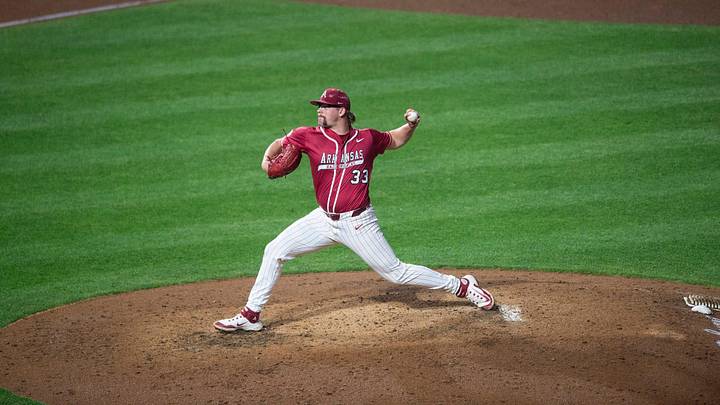
Even though it was a down year for Arkansas baseball (41-22, 17-13 SEC), one where the Razorbacks lost several games they should not have, including against Arkansas State, Missouri State, University of Texas-Arlington, and Stetson, the team developed into one of the best in the country, winning seven of 10 SEC series contests and defeating some of the most elite teams in the nation, including Georgia, Texas, Auburn, and Mississippi State.
Despite Dave Van Horn receiving assurances that the Hogs had done enough in the second half of the season and in the SEC Tournament, the NCAA surprisingly denied Arkansas an opportunity to host a regional. Instead of enjoying hosting a regional at Baum-Walker Stadium, as they truly earned the right to do, the NCAA Selection Committee sent the Razorbacks to the Lawrence Regional, where they ultimately fell in the regional finals to Kansas, losing both games against the Jayhawks.
Although the Hogs' season ended in the NCAA Lawrence Regional, a place at the beginning of the season many would not have expected it to end, as going to Omaha each season to compete for the College World Series is the standard at Arkansas, Razorback Nation must never take for granted the elite college baseball program the Razorbacks have. When one's baseball program can accomplish the previously mentioned things during a down year, that is a program one must be truly grateful for, especially in this increasingly competitive NIL and transfer portal era.
Surprisingly, though Razorback Nation is unaccustomed to experiencing down seasons under Van Horn's leadership, Arkansas' pitching proved to be its greatest weakness. This weakness plagued the Hogs all season, including causing it to lose the aforementioned games it never should have lost, and causing it to find itself in the NCAA Lawrence Regional and to suffer two losses to a Kansas team that, under a typical Van Horn season, the team would have handled with limited stress.
Ethan McElvain named a finalist for Stopper of the Year Award
Although pitching was the central weakness for the Razorbacks this season, Arkansas had two ace pitchers, Hunter Dietz, one of the Hogs' best starting pitchers in team history, and one of the best in college baseball history, and Ethan McElvain, a relief pitcher designated as the team's closer. Even though McElvain served as the closer, he was much more than a closer. He proved himself to be such an asset out of the bullpen that Van Horn brought him into the game in the most critical and stressful moments, where the game depended on a relief pitcher coming into the game to save the game for the Hogs before an official save could be awarded.
McElvain had a remarkable season, finishing with a 1.88 ERA, 6-0 record, and six saves. Given that he was brought in to restore order in many of the chaotic games Arkansas had this season due to its horrible starting pitching, he was credited with a much higher number of saves, which is why reading his number of saves without proper context leads to an egregious misreading of his significant impact for the Razorbacks. He appeared in 20 games and pitched 38.1 innings, posting a .182 OPP BA and 1.03 WHIP.
As impressive as those numbers are, several finalists for the National Collegiate Baseball Writers Association (NCBWA) Stopper of the Year Award have better numbers. If the award is going to focus solely or primarily on the numbers, then the NCBWA need not have 14 finalists; it can simply choose the pitcher with the best numbers in any category or categories. However, if the award is to possess genuine significance, it should go to the pitcher who had the most value for his team, in the most crucial games and moments, and who had some of the best numbers in multiple categories in the nation.
The NCBWA should not abandon statistics when selecting the Stopper of the Year Award winner. McElvain has excellent numbers. However, the value a pitcher has for his team should weigh much more heavily. He was on a team with only one reliable starter. McElvain had to confront a constant level of intense pressure that the other 13 finalists did not, especially given the Razorbacks' inadequate starting pitching and grueling schedule. Understanding those vital elements, Arkansas' ace closer should have the edge in the final selection process.
 Add us as a preferred source on Google