

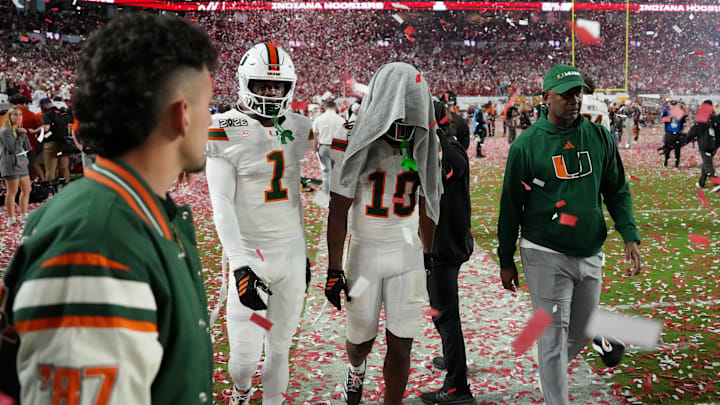
Miami’s College Football Playoff run was nearly historic, and more importantly, it showed exactly why the expanded playoff is working. The Hurricanes came within one win of completing one of the greatest postseason runs of the CFP era, nearly topping what Ohio State accomplished a year ago as a No. 8 seed that stormed its way to a national title.
Miami Hurricanes Leading a CFP Shake-Up
Miami almost did it as a No. 10 seed who was on the brink of almost not even making it completely.
They barely made the field, not officially earning a spot until the final CFP rankings were released, edging out Notre Dame amid heavy debate about who truly deserved to get in. That drama alone captured the spirit of the playoff. Once Miami got its chance, they proved what the CFP was designed to do: give teams an opportunity to settle it on the field.
Miami was only favored against one team being Ole Miss in their playoff run which is telling of the gauntlet they had to go through to get to the spot they were in. Still, they kept advancing; playing loose, confident, and dangerous, until they reached the national championship game, where they nearly took down the top-ranked Indiana Hoosiers. That run embodied the phrase that defines college football: Any given Saturday.
What Miami proved is simple: rankings don’t matter once the bracket is set. They also showed the importance of never writing off a team midseason and using the full season to define a team’s identity. Many viewed Miami as a castoff from a perceived weak ACC, but that perception couldn’t have been further from the truth. The Hurricanes dominated SEC teams and were even more physical than Big Ten powerhouse Ohio State, an uncommon feat for non-conference matchups. Miami controlled the trenches on both sides of the ball, and that dominance was truly impressive.
The expanded playoff has also exposed a growing trend, the so-called advantage of a top-four seed and a first-round bye may actually be a disadvantage. Over the past two seasons, seven of the eight teams that received byes lost their first playoff game. Only Indiana broke the trend this year. Meanwhile, lower-seeded teams with momentum, confidence, and a chip on their shoulder have thrived. In back-to-back years, a No. 8 seed and a No. 10 seed reached the final.
Why Arkansas Should Be Excited About What’s Ahead
That reality should resonate loudly in Fayetteville.
For Arkansas, Miami’s run should be viewed as a glass-half-full moment, not a discouraging one. The goal doesn’t have to be perfection or dominance from day one, it’s about getting hot at the right time. If the Razorbacks can get the rebuild humming, find chemistry, and gain momentum the way Ryan Silverfield has started to do, simply making the playoff field changes everything.
College football parity is tighter than it’s ever been, and with rumors of the CFP potentially expanding to 16 teams, opportunities are only growing. Teams no longer need to be flawless all season putting extra pressure on each week that goes by. College football is turning into more of a marathon not a sprint. The mentally strong and best coached teams make the runs. They need to be dangerous when it matters.
Miami showed the blueprint. Get in the dance, believe, and let the games decide.
Now it’s up to Arkansas to see that path, and realize they could be next.
 Add us as a preferred source on Google