

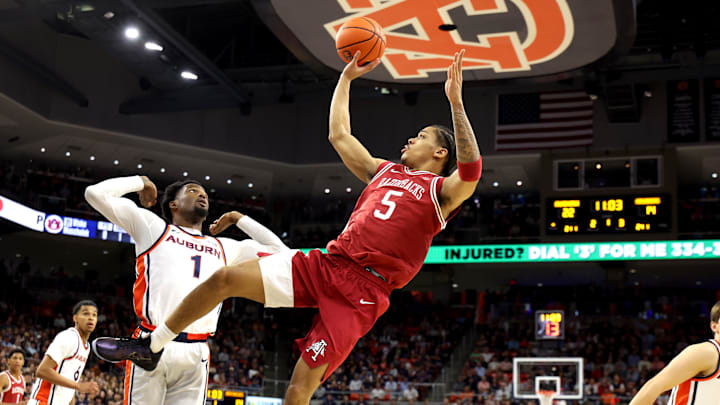
When discussing the 2026 NBA Draft, three freshman point guards consistently dominate the conversation: Darius Acuff, Mikel Brown, and Kingston Flemings. All three are elite talents. All three project as potential NBA lead guards. Yet despite matching, or outright surpassing, his peers in production and efficiency, Acuff continues to lag behind in national draft conversations. According to college basketball draft analyst Christopher Kline, he has Acuff going third out of the three guards in his latest mock draft.
The question is simple: why?
Darius Acuff Is Producing at an Elite Level
From the opening weeks of the season, Darius Acuff has looked the part of a future NBA initiator. The Arkansas freshman has thrived against one of the toughest nonconference schedules in the country and has emerged as the focal point of a top-20 Razorbacks team entering SEC play.
Offensively, Acuff checks nearly every box scouts look for in a modern lead guard. He’s explosive when attacking downhill, comfortable creating separation, and deadly from beyond the arc. He’s shooting an efficient 48.7% from the field and an elite 42.5% from three, while averaging 19.9 points per game. Perhaps most impressive is his command of the offense: Acuff is posting an excellent assist-to-turnover ratio of roughly 5.9 assists to just 2 turnovers while handling the majority of Arkansas’ ball-handling responsibilities.
For a true freshman, that level of efficiency and decision-making is rare.
Comparing Mikel Brown to Acuff
Mikel Brown’s creativity and playmaking flair are undeniable. The Louisville guard is dynamic out of the pick-and-roll, flashes deep pull-up range, and consistently bends defenses with his vision. Even with uneven shooting efficiency, his impact remains clear.
However, when stacked side-by-side, Acuff’s production is simply stronger. Acuff averages more points (19.9 vs. 16.6), shoots significantly better from the field and from three, and distributes at a comparable, if not slightly better, rate, with 5.9 assists to Brown’s 5.1. While Brown’s shooting is often excused as “self-correcting,” Acuff is already converting at a high level against elite competition. So less adjustment period for his jumper to start falling than Brown.
Brown may carry gravity. Acuff converts it into results.
Comparing Kingston Flemings to Acuff
Kingston Flemings entered the season with quieter expectations but has rapidly risen into PG1 conversations thanks to his speed, finishing ability, and defensive impact. He’s exceptional at getting to his spots and remains one of the most disruptive defensive guards in the class, averaging around two steals per game.
That defensive edge matters, and it’s the clearest separator between the two.
Still, offensively, Acuff again outpaces his peer. He scores more (19.9 vs. 15.7), distributes more (5.9 assists to Flemings’ 5.1), and shoots better from three (42.5% to 40%). While Flemings currently offers more defensive playmaking, Acuff isn’t a disengaged defender, he’s active, competes, and positions well, even if his stock numbers lag behind.
If Acuff can make even marginal improvements defensively, the gap narrows quickly.
So Why Isn’t Acuff Getting More Love?
One element often overlooked in draft discourse is context. Acuff isn’t just producing, he’s doing it as the primary engine of a top ranked Arkansas team, coached by John Calipari, that navigated one of the most demanding non-conference schedules in the country. He’s not playing off another star. He’s driving the offense.
That matters.
NBA teams covet guards who can shoulder responsibility, manage pressure, and still score efficiently. Acuff has already shown he can do that as a freshman against high-level opponents. His offensive polish, shot-making versatility, and poise are already at an NBA-caliber baseline.
The concerns are clear: size, defensive utility, and low stock numbers. Those questions won’t disappear overnight. But when viewed through the lens of offensive impact, efficiency, and on-ball responsibility, Acuff has been arguably better than the guards currently projected ahead of him.
Brown is creative. Flemings is disruptive.
Acuff is complete.
As SEC play unfolds and Arkansas continues to lean on him, the gap between perception and production will become harder to ignore. If the conversation is truly about who’s playing the best basketball right now, not just who fits an archetype, Darius Acuff belongs firmly in the top tier of the 2026 NBA Draft discussion but the more he doesn't hear his name talked about the bigger the chip on his shoulder gets.
And the longer he keeps producing like this, the louder that conversation will get.
 Add us as a preferred source on Google