

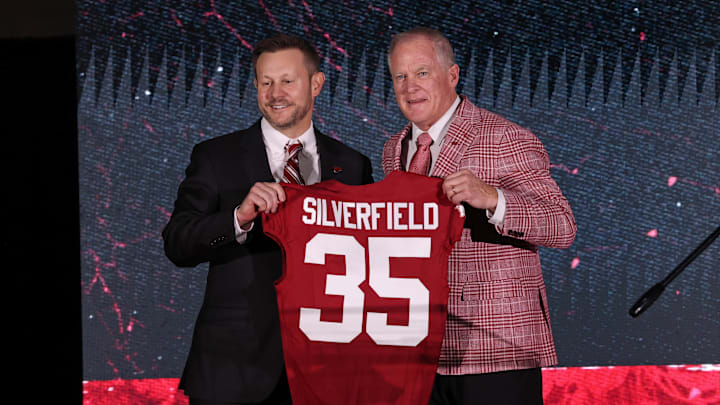
Arkansas head coach Ryan Silverfield has already shown he understands one of the most important realities of modern college football: recruiting no longer lives in just one lane. Between the transfer portal and high school ranks, Silverfield has proven he can identify, evaluate, and bring talent into the program from multiple avenues. That alone is no small feat in today’s landscape.
But as important as recruiting is, it’s only half the battle.
The next, and arguably most critical, challenge Silverfield must conquer at Arkansas is roster retention.
Retention Becomes Key Hurdle for Razorbacks Football
In today’s college football world, retaining players has become just as valuable as landing them. Getting talent into the building is essential, but keeping that talent in the building is what allows programs to build continuity, develop players, and ultimately sustain success. Continuity between players, position groups, and coaching staffs creates chemistry, trust, and long-term growth, things that can’t be rushed or replaced overnight.
Sustaining success is the real separator. Anyone can catch lightning in a bottle for a season, but maintaining a competitive standard year after year is what defines strong programs. And in an era where patience is rapidly disappearing, the margin for error is smaller than ever. Programs expect results quickly, and if they don’t get them, they’ll find someone who can deliver.
Silverfield’s background does offer some reassurance. Recruiting has increasingly become a focal point for him, especially as NIL has reshaped the sport. For Group of Five programs, the challenge is even steeper. Retaining top players is incredibly difficult when Power Four schools can step in with bigger paychecks, larger platforms, and immediate starting opportunities.
More often than not, the best players at the Group of Five level are essentially on borrowed time. Once they prove they can play, they become targets. That reality forces coaches like Silverfield to constantly stay active in the portal and on the recruiting trail, searching for replacements while simultaneously developing the next wave of contributors.
Development, in fact, is another area Silverfield has had to sharpen. With starters frequently changing year to year due to transfers, Group of Five coaches must develop players quickly and efficiently. Depth charts are fluid, and progress can’t be slow. That environment has helped Silverfield become accustomed to roster churn and rapid evaluation, skills that matter at any level.
However, Arkansas presents a different opportunity, and expectation.
Silverfield doesn’t want Arkansas to become a middle ground or a temporary launching pad. The Razorbacks can’t afford to be a place where players arrive, enjoy a breakout “prove-it” season, and immediately leave for more money and exposure elsewhere. To take the next step, Arkansas must become the destination, not the stepping stone.
That means creating an environment where players believe they can develop, compete at a high level, and get compensated without having to leave. Retention becomes a statement of program health. When players stay, it signals belief: in the coaching staff, the culture, and the vision.
It’s also important to note that Silverfield’s first offseason won’t fully reflect his ability to retain talent. He inherited a roster that required significant turnover, making an overhaul inevitable. That initial reset clouds the evaluation.
The real test begins in Year 2 and beyond.
That’s when patterns emerge. That’s when cracks start to show, or stability begins to form. Either players will buy in and stay, or the cycle of turnover will continue. Those seasons will reveal whether Silverfield was truly ready for the jump in competition that comes with leading the Razorbacks.
Recruiting and talent acquisition brought him here. Development has kept him competitive. Retention is what will define his tenure.
In today’s college football climate, getting good is hard. Staying good is harder. And for Ryan Silverfield and Arkansas, learning how to keep their best players may be the difference between short-term success and something sustainable.
 Add us as a preferred source on Google