

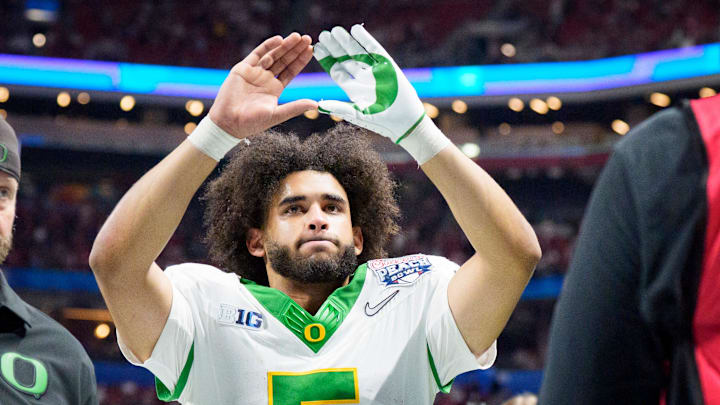
In an era of instant gratification fueled by the transfer portal, NIL pressure, and fan impatience, Oregon may be quietly changing the way college football thinks about quarterback development. And if Arkansas football is paying attention, there’s a blueprint here worth following.
For years, the prevailing mindset has been simple: if a quarterback has talent and hype, get him on the field immediately. But Oregon has gone the opposite direction, and the results are speaking for themselves.
The Dante Moore Example: Development Over Urgency
When Dante Moore arrived at UCLA as a highly touted recruit, expectations were sky-high. Like many young quarterbacks before him, he was thrust into action early. The results were uneven. Moore struggled during his freshman season, was benched, and found himself in the middle of organizational chaos when Chip Kelly was eventually fired.
Rather than force the issue or chase immediate playing time elsewhere, Moore made a decision that now looks pivotal: he transferred to Oregon knowing full well he wouldn’t start right away.
Sitting behind veteran Dillon Gabriel wasn’t something Moore was used to, or likely envisioned, but he embraced it. He learned. He developed. And when his opportunity came in 2025, Moore looked like a completely different quarterback. His growth was evident not just on the field, but in how NFL evaluators viewed him. Moore played so well that he was already being discussed as a legitimate pro prospect before choosing to return to school for even more development.
That decision alone speaks volumes about the culture Oregon has built around patience and long-term growth.
Oregon Is Doing It Again and It’s Not an Accident
Now, the Ducks find themselves in a similar situation with Dylan Raiola, the former five-star recruit who struggled during his time at Nebraska. Instead of selling immediate stardom, Oregon is once again emphasizing development.
The message is clear: talent matters, but readiness matters more. Preparation comes with confidence and that ends up with team success.
Accepting a “sit a year” mentality isn’t easy in today’s college football climate. But Oregon has normalized it. They’ve turned it into a feature, not a flaw. And more programs around the country should be paying close attention.
Arkansas Football Needs to Use This Approach Now
This is where Arkansas football comes in.
The Razorbacks have intriguing young quarterbacks on the roster. AJ Hill brings upside. High school recruit Hank Hendrix adds even more long-term potential. The temptation to play these guys early, especially with the promise of excitement and future stardom, is real.
But that temptation needs to be resisted.
Arkansas has options. KJ Jackson provides a little more seasoned presence, and the addition of portal quarterback Braeden Fuller from Angelo State gives the Razorbacks flexibility. Those options create something invaluable: time.
Time to let young quarterbacks learn without pressure.
Time to let mistakes happen in practice, not under SEC lights.
Time to develop confidence, mechanics, and game understanding at the right pace.
Razorback fans crave excitement, and understandably so. A young quarterback, or quarterbacks, with sky-high potential can energize a program overnight. But excitement doesn’t always equal progress.
Sometimes the best move is the boring one. Sometimes the smartest decision is patience. Sometimes development beats hype. Oregon is one of the best programs in the country for a reason. Their quarterback room isn’t built on urgency, it’s built on preparation. If Arkansas truly wants long-term success at the position, the path is clear and it's ok to follow the path of other programs starting trends around the country, especially if it works.
Follow the Ducks.
 Add us as a preferred source on Google