

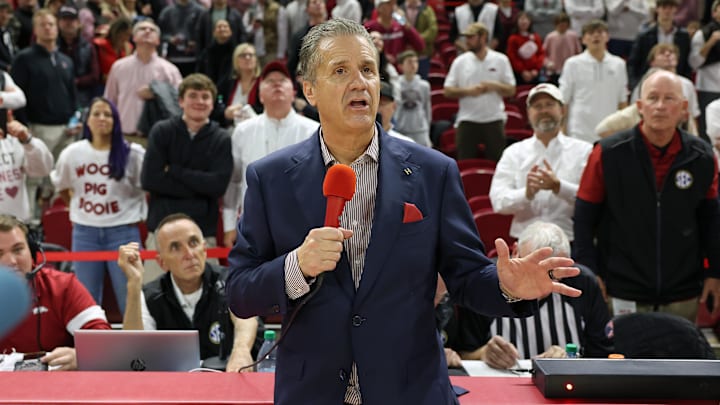
John Calipari’s recent viral video discussing college basketball eligibility has ignited a wave of debate across the sport, exposing growing concerns about how NCAA rules are being applied—and who they truly protect. What began as a hypothetical discussion has quickly turned into a real-world issue as more professional players attempt to enter the college ranks.
The conversation first gained traction with the case of James Nnaji. A former second-round pick in the 2023 NBA Draft, Nnaji recently entered the college basketball landscape after committing to Baylor. At 23 years old, Nnaji has not appeared in an NBA regular-season game, only spending time in the Summer League. Still, his path has raised eyebrows. Despite being drafted and professionally affiliated with the NBA, he is now eligible to compete in college basketball, something that feels, to many fans, like a loophole waiting to be exploited.
That unease intensified with another name entering the conversation: Trentyn Flowers. Unlike Nnaji, Flowers has already logged NBA experience, having played for the Los Angeles Clippers and currently residing with the Chicago Bulls on a two-way contract. The idea that a player with NBA minutes could potentially be recruited into the college game pushed Calipari’s warning into the spotlight.
College Basketball Fans Sound Off
As reactions poured in on X (Twitter), college football writer for yahoo sports and contributer for ON3 sports shared an official update from NCAA President Charlie Baker, stating:
"“The NCAA has not and will not grant eligibility to any prospective or returning student-athletes who have signed an NBA contract.”"Charlie Baker
NCAA president Charlie Baker: "The NCAA has not and will not grant eligibility to any prospective or returning student-athletes who have signed an NBA contract." pic.twitter.com/PZtAq3pre6
— Ross Dellenger (@RossDellenger) December 30, 2025
While the statement appears firm on the surface, many fans and analysts believe it fails to address the core issue. Baker’s wording specifically references NBA contracts, but leaves unanswered questions about international players or those who were drafted, developed professionally overseas, or spent years in NBA systems without technically signing standard NBA contracts.
The concern is that foreign players or fringe professionals could take advantage of these gray areas, returning to college basketball older, stronger, and more developed than true amateur athletes. Critics argue that these players had the same opportunity to attend college before declaring for the draft, just like their American counterparts, and allowing them back undermines the competitive balance of the sport.
Media personality Matt Jones, host of Ky Sports Radio and an ESPN Radio NFL preview show, offered a more measured take. He wrote:
"“This seems like to me, a perfectly reasonable line for the NCAA to have (this is the NCAA President). If you sign a NBA contract, you are out. If you are a Euro or G League contract, you can still come back. If this line holds, then I think it can work for college basketball.”"Matt Jones
This seems like to me, a perfectly reasonable line for the NCAA to have (this is the NCAA President). If you sign a NBA contract, you are out. If you are a Euro or G League contract, you can still come back
— Matt Jones (@KySportsRadio) December 30, 2025
If this line holds, then I think it can work for college basketball https://t.co/Aqd3eSJxzw
Jones’ stance aligns with Baker’s logic, but even supporters of this approach admit it still fails to protect amateur players fully. Allowing former professionals, regardless of league, to return to college risks taking away roster spots, minutes, and development opportunities from athletes who followed the traditional path.
Another strong reaction came from the basketball-focused account Hoop Herald, which posted:
“Blank check for John Calipari to run the NCAA. Some of this is common sense, but for some reason it’s not common.”
Blank check for John Calipari to run the NCAA
— Hoop Herald (@TheHoopHerald) December 28, 2025
Some of this is common sense, but for some reason it’s not common
pic.twitter.com/pyg8WGmJD5
That sentiment resonated widely, echoing a familiar argument in college sports. Just as some college football fans believe Nick Saban should oversee the future of that sport, many now view Calipari as the voice of reason in a rapidly changing college basketball landscape.
The idea of Calipari running college basketball, and Saban running college football, may sound exaggerated, but it highlights a deeper frustration. Fans want leadership from people who understand both player development and competitive integrity. Until the NCAA delivers clearer, more comprehensive eligibility rules, the chaos Calipari warned about may only continue to grow.
College sports thrive on fairness and opportunity. Without firm boundaries, that foundation risks being eroded, one viral video at a time.
 Add us as a preferred source on Google