

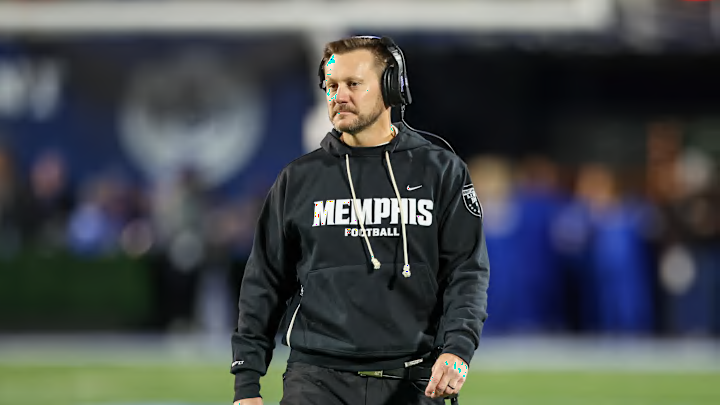
Arkansas football is trying something different and it’s noticeable before a single snap is played.
Under new head coach Ryan Silverfield, the Razorbacks are leaning into a growing trend across college football: stockpiling assistants across the entire staff on both sides of the ball. According to Arkansas’ newly posted organizational chart, the program now boasts 12 full-time assistants, a significant shift from the Sam Pittman era, when the Razorbacks stayed close to the old NCAA limit of 10.
That change is not accidental.
Pittman was very open about the financial realities that shaped his staff decisions. Athletic director Hunter Yurachek openly acknowledged in past years that Arkansas didn’t always have the financial flexibility of some SEC peers. That tone has changed. Yurachek has made it clear that money will not be as much of an “issue” for this coaching staff as it may have been for previous regimes and the expanded assistant pool is the first tangible proof of that promise.
The question now becomes: Is this too much, or is this simply the new reality of college football?
A Different Way to Build a Program
The logic behind adding more assistants is straightforward. More coaches allow responsibilities to be divided more precisely, giving each assistant clearer roles and narrower focus areas. That means more eyes in practice, more detailed film breakdowns, more specific weight-room evaluations, and more individualized development plans for players.
In theory, this structure should help Arkansas better evaluate who deserves more, or less, playing time. Instead of relying on broad assessments, coaches can zero in on smaller position groups and track development with greater accuracy. For a program trying to rebuild depth, confidence, and consistency, that level of detail matters. The attempt to try something different can do wonders for the team as they've been stuck with losing seasons the old way of how things went before.
Targeting the Weak Spots: Secondary and Offensive Line
Silverfield hasn’t been subtle about where Arkansas struggled last season. The offensive line and the secondary were problem areas, and rather than hoping those issues fix themselves, he addressed them directly.
Arkansas now employs two offensive line assistants and two secondary assistants, a clear signal that those position groups are a priority. It’s an encouraging sign early in Silverfield’s tenure. While last year’s struggles weren’t his responsibility, he wasn’t there yet, his willingness to attack known weaknesses shows self-awareness and urgency.
The old saying applies here: actions speak louder than words.
A Program-Wide Reset
This army of assistants and analysts signals something larger than just schematic tweaks. Silverfield is operating like a coach who understands that everything needs rebuilding from culture, roster development, communication, and accountability. This will also allow him to be able to oversee operations on a day to day and dip his hands into every area he sees necessary having thr right support around him.
For years, Arkansas preached toughness and development while operating with limited resources. Now, the Razorbacks are finally spending like a true SEC program. More coaches mean more teaching, more ideas, and fewer excuses.
Of course, an impressive organizational chart doesn’t guarantee wins. Time will ultimately decide whether this expanded staff becomes a competitive advantage, an unnecessary luxury, or something in between. But one thing is already clear: Arkansas football is no longer standing still.
Silverfield is trying to drag the program into the modern era of college football. Whether “more is better” remains to be seen, but the Razorbacks are no longer pretending the old ways are enough.
 Add us as a preferred source on Google