

Rebuilds in college football are rarely linear, and they’re almost never quick. Arkansas fans know that reality all too well. Year after year, hope arrives in the offseason, only for fall Saturdays to remind Razorback supporters how hard sustained success in the SEC really is. New coaches, new philosophies, and familiar disappointment have defined the last stretch in Fayetteville.
But if Indiana football has taught the sport anything recently, it’s this: the right blueprint, executed with conviction, can flip a program faster than anyone expects.
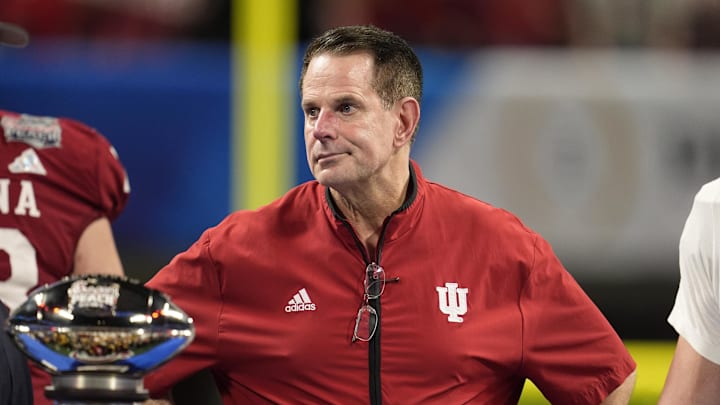
That blueprint belongs to Curt Cignetti.
The Curt Cignetti Blueprint
When Cignetti arrived in Bloomington, Indiana was closer to the Big Ten basement than relevance. Two years later, the Hoosiers went from worst to first, fueled by what quarterback Fernando Mendoza famously dubbed a “band of misfits.”
That phrase perfectly captures Cignetti’s approach.
Rather than waiting years for high school recruiting classes to mature, Cignetti attacked the transfer portal with precision. He identified experienced players who had been overlooked, undervalued, or stuck in poor situations, and gave them a clear vision, defined roles, and a culture built on winning.
In Year 1, the portal was the foundation. Familiar faces from James Madison followed him to Bloomington, creating instant buy-in and scheme continuity. That core stabilized the locker room while newcomers from other programs blended in around them.
Once Indiana had its footing, the approach evolved. The Hoosiers didn’t abandon the portal, but they didn’t live exclusively in it either. High school recruiting improved, roster retention became a priority, and the portal turned from a crutch into a supplement. The message was simple: winners want to play with winners. And Cignetti is a winner.
That combination, portal mastery, developmental recruiting, and retention, turned Indiana into one of the most compelling rebuild stories in the country.
Now, Arkansas finds itself staring at that same blueprint.
Arkansas Football Faces Another Defining Moment
The Razorbacks are once again at the beginning of something new. Years of constant optimism without tangible results have worn thin. Coaching turnover has prevented stability, and the SEC’s unforgiving nature has exposed every roster flaw imaginable.
Enter Ryan Silverfield.
Early in his Arkansas tenure, Silverfield has faced a harsh reality: heavy roster attrition. The portal didn’t just become an option, it became a necessity. But what’s encouraging is how he’s using it.
This hasn’t been a scattershot rebuild.
It’s been targeted. Purposeful. Strategic.
Silverfield’s Transfer Portal Strategy
Silverfield identified problems and attacked them immediately.
Quarterback depth? A glaring issue. Instead of hoping one option would pan out, he went and got two. Competition, insurance, and flexibility, all addressed in one cycle.
Secondary struggles? One of the worst units in the SEC a season ago. Silverfield responded by bringing in legitimate game changers, players capable of transforming the unit rather than simply patching holes.
Offensive line? Not a disaster, but not a strength. In the SEC, that’s unacceptable. Games are won and lost in the trenches, and Silverfield knows it. He’s working to turn the offensive line into an advantage, not just something that survives Saturday afternoons.
What stands out most is that this rebuild isn’t reactionary, it’s proactive.
Another key similarity between Silverfield and Cignetti lies in continuity.
Silverfield brought in players who have already played under him and within his schemes during his time at Memphis. That matters more than it gets credit for. Those players serve as on-field extensions of the coaching staff, helping teammates adjust, learn terminology, and understand expectations faster.
Cignetti did the same in Bloomington, importing trusted veterans from James Madison in Year 1. It shortened the transition period and allowed Indiana to be competitive immediately.
Silverfield is clearly learning on the fly, but he’s doing so with purpose.
Can Arkansas Be Indiana 2.0?
That’s the million-dollar question.
The SEC is not the Big Ten, and Arkansas’ climb will be steeper than Indiana’s was. There are no shortcuts through Alabama, Georgia, or LSU. But the blueprint exists. It’s proven. And Silverfield appears to be following it closely.
The early signs are encouraging but at the end of the day, execution will decide everything as it always does. Recruiting rankings don’t win games, players do. Stars attached to your name, dont matter. Competitors want to win with competitors.
Curt Cignetti built that culture in Bloomington with a band of misfits who believed in the plan.
Now, Silverfield has his own.
If it happened once, it can happen again. Easier said than done, but not impossible. Arkansas’ rebuild is underway, and the path to relevance has already been drawn. Now it’s time to see if Silverfield and his Razorbacks can walk it.
 Add us as a preferred source on Google