

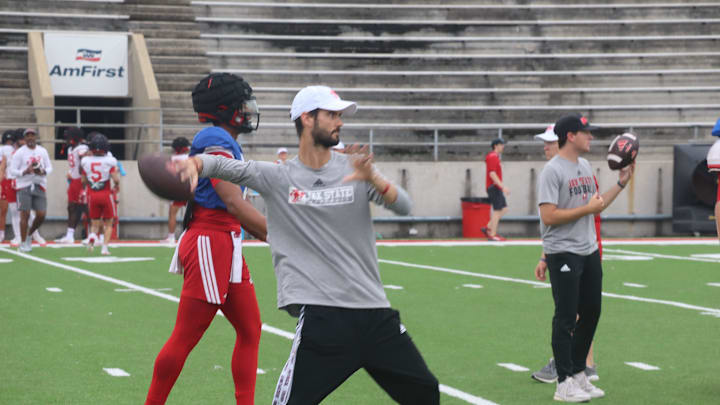
Clint Trickett’s coaching career didn’t emerge from the fast track. Instead, it was forged through patience, competition, and adaptability taking lessons learned during a playing career that rarely offered him the spotlight but ultimately prepared him for life on the sideline.
Learning Patience in a Crowded Quarterback Room
A true freshman at Florida State in 2010, Trickett entered a quarterback room stacked with talent and experience. Christian Ponder, a redshirt senior, had a firm grasp on the starting job, while E.J. Manuel, a redshirt sophomore, was already in his third season, waiting for his turn. For a young quarterback still learning the college game, opportunity was scarce. In an era before the transfer portal was what it is today with quick exits, patience was often the only option and tested his patience.
As Trickett worked his way through the depth chart, the competition only intensified. Perhaps the most recognizable name he encountered was Jameis Winston, who arrived as a redshirt freshman and quickly separated himself during the 2013 spring camp. Winston went on to lead the Seminoles to their first national championship since 1999, defeating Gus Malzahn and Auburn, while also becoming a Heisman Trophy winner.
Recognizing the situation, Trickett made a pivotal decision. He graduated early from Florida State, betting on himself by transferring in search of an opportunity to start. That gamble led him to West Virginia, a move that would shape his football future far beyond his playing days.
Adapting to Offensive Systems and Forming a Coaching Identity
At West Virginia, Trickett entered a drastically different offensive world. Head coach Dana Holgorsen ran an Air Raid system, spread-based and pass-heavy, standing in stark contrast to Jimbo Fisher’s balanced, pro-style offense at Florida State. Learning two distinct offensive philosophies gave Trickett a broader understanding of the game, one that would later become foundational to his coaching identity.
"“Two different styles of offense, going from Jimbo’s pro-style to Dana’s, that obviously helped going into the coaching career,” Trickett said on an episode of QB Spotlight while serving as Marshall’s offensive coordinator. “I try to use a little bit of a blend of both here.”"Clint Trickett
That blend became evident as Trickett transitioned into coaching. He first cut his teeth on a national stage as the quarterbacks coach at East Mississippi Community College from 2015–16, where the pressure-packed environment sharpened his teaching and leadership skills. From there, he continued developing under one of the game’s most innovative minds, Lane Kiffin, at Florida Atlantic from 2017–19. During that stint, Trickett also spent a season working alongside Kendal Briles, further expanding his offensive toolbox. Learning under both of those offensive mastermind's has served him well over his young coaching career.
Trickett Rising Through the Ranks and Bringing Experience to Arkansas
More recently, Trickett has made his mark as the offensive coordinator at Jacksonville State. This season, the Gamecocks led Conference USA with 419.2 yards per game, showcasing a prolific offense that leaned heavily on a dominant rushing attack. Jacksonville State averaged 258 yards per game on the ground and scored 31 rushing touchdowns, with star running back Cam Cook serving as the engine of the offense. While the passing game took a back seat at times, the production underscored Trickett’s adaptability and willingness to tailor his system to personnel, another lesson rooted in his own playing experience and one that will help his time with the Razorbacks.
Now, Trickett brings that wealth of experience to Arkansas as part of a revamped Razorback coaching staff. His journey, from backup quarterback to transfer, from learning multiple offensive systems to proving himself as a play-caller, has shaped the philosophies he carries today. He’s risen through the ranks, and his résumé as an offensive coordinator shows that his concepts can succeed at a high level.
His background working with Kendal Briles and Lane Kiffin will continue to serve him well, especially as he collaborates with Arkansas offensive coordinator Tim Cramsey. Cramsey, who followed head coach Ryan Silverfield from Memphis, is known for employing multiple schemes and varying tempo to control the flow of games. That versatility meshes naturally with Trickett’s blended offensive mindset.
For Trickett, this next chapter in Fayetteville represents both an opportunity and a proving ground. Learning and coaching in the SEC, the highest level of college football, positions him to continue climbing beyond the “quarterbacks coach” label. Just as his playing career prepared him for the long road, his coaching journey suggests that Clint Trickett is far from finished rising.
 Add us as a preferred source on Google