

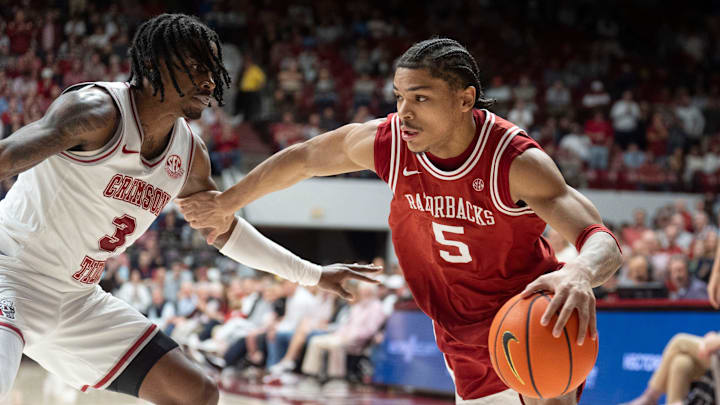
Each year, the Naismith Memorial Basketball Hall of Fame presents the Bob Cousy Award to the most outstanding point guard in men’s college basketball. The award honors excellence at the position: balancing scoring, playmaking, leadership, and impact on team success. Among this year’s finalists, the numbers and overall résumé point strongly toward one player standing above the rest: Darius Acuff Jr..
Darius Acuff Jr. Has the Strongest Case for the Bob Cousy Award
Acuff’s statistical profile immediately separates him from the competition. He leads all finalists with 22.2 points per game, while also contributing 3.0 rebounds and 6.4 assists per game. Even more impressive is how efficiently he produces those numbers. Acuff is shooting 49.3% from the field and 43.7% from three-point range, elite marks for a high-usage guard.
When compared to the other finalists, the scoring gap becomes clear:
- Braden Smith: 14.9 PPG, 8.7 APG, 46.2% FG, 38.8% 3PT
- Kingston Flemings: 16.5 PPG, 5.4 APG, 48.3% FG, 37.6% 3PT
- Jeremy Fears Jr.: 15.3 PPG, 9.1 APG, 44.6% FG, 30% 3PT
- Jaden Bradley: 13.9 PPG, 4.5 APG, 46.6% FG, 35% 3PT
Darius Acuff-22.2ppg 3.0rpg 6.4apg 49.3%FG, 43.7% 3P
— Chris Brewer (@chrisbrewer10) March 9, 2026
Braden Smith-14.9ppg 3.6rpg 8.7apg 46.2%FG, 38.8% 3P
Kingston Flemings-16.5ppg 3.9rpg 5.4apg 48.3%FG, 37.6% 3P
Jeremy Fears Jr-15.3ppg 2.4rpg 9.1apg 44.6%FG, 30% 3P
Jaden Bradley-13.9ppg 3.5rpg 4.5apg 46.6%FG, 35% 3P pic.twitter.com/UW9jrF4UKN
Acuff scores nearly six points more per game than the next closest finalist, a significant margin at the highest level of college basketball. That kind of offensive production cannot be ignored in a discussion about the nation’s best point guard.
The argument for Acuff becomes even stronger when looking beyond raw scoring totals. His 49.3% field-goal percentage and 43.7% three-point shooting show that he is not simply a high-volume scorer. Instead, he produces efficiently while carrying the offensive load for his team.
This balance between scoring and efficiency is rare for a primary ball handler. Many guards who average over 20 points per game do so while sacrificing shooting percentages due to defensive attention and shot volume. Acuff, however, has maintained elite efficiency while remaining the centerpiece of his team’s offense.
Critics may point to assist totals as the area where Acuff does not lead the field. Both Jeremy Fears Jr. (9.1 APG) and Braden Smith (8.7 APG) post higher numbers.
However, context matters.
Both Fears and Smith are veteran guards with multiple seasons of experience at the collegiate level. Acuff, meanwhile, is producing 6.4 assists per game in his first season, while also serving as the most dynamic scoring threat among the finalists. His role requires balancing shot creation and playmaking, something he has done at a high level all season.
Statistics tell a large part of the story, but the award also considers leadership and impact on team success. Like the other finalists, Acuff has guided his team to a successful season while functioning as the engine of the offense.
What makes his case particularly compelling is the responsibility he carries. As the primary scorer, primary ball handler, and offensive initiator, Acuff has consistently delivered in high-pressure situations. His ability to control games, create shots for himself and others, and stretch defenses with elite shooting has been central to his team’s success.
The Total Résumé
When evaluating the finalists for the Bob Cousy Award, the criteria extend beyond one statistical category. The award recognizes the point guard who best combines production, efficiency, playmaking, leadership, and overall impact.
Across the totality of those categories, Darius Acuff Jr. stands out.
He leads the field in scoring by a wide margin, does so with elite efficiency, still contributes strong playmaking numbers, and carries the offensive responsibility of a premier guard. When all factors are considered together, Acuff’s résumé presents the clearest and strongest case.
The numbers, and the context behind them, make the argument difficult to ignore. If the award is truly meant to honor the most outstanding point guard in the country, the case for Acuff is clear.
 Add us as a preferred source on Google