

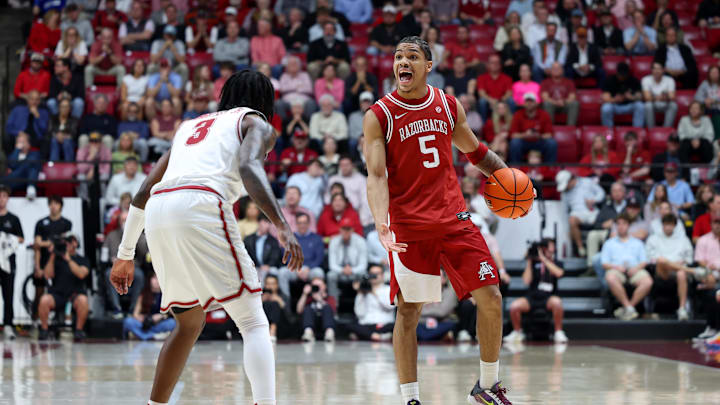
The race to become the top guard in the 2026 NBA Draft is far from settled. For much of the past year, Darryn Peterson has held that title in the eyes of scouts and national recruiting outlets. But as the season unfolds, a new name is gaining serious traction: Darius Acuff Jr..
With growing questions surrounding Peterson’s motor and durability, and Acuff’s star rising by the week, the conversation about who truly deserves to be the draft’s top guard is heating up.
The Darryn Peterson Paradox: Talent vs. Urgency
There’s no debating Peterson’s ability. The Kansas guard is one of the most gifted scorers in college basketball, averaging 20 points per game on an efficient 49% shooting from the field and 43% from three-point range. His scoring package is polished, versatile, and NBA-ready. From shot creation to perimeter efficiency, the tools are evident.
But talent has never been the concern.
Effort and engagement, however, have become part of the discussion. When respected analyst Jay Williams publicly stated, "If I were a general manager, I would be extremely concerned about Darryn Peterson. ... His talent is unquestionable. It's elite. But I don't feel like he really wants to be there.", it sends ripples through social media. That’s not a casual remark, especially coming from someone with Williams’ credibility and experience evaluating elite prospects.
"If I were a general manager, I would be extremely concerned about Darryn Peterson. ... His talent is unquestionable. It's elite. But I don't feel like he really wants to be there."
— Get Up (@GetUpESPN) February 19, 2026
—@RealJayWilliams on Peterson's availability this season amid NIL dynamics 👀 pic.twitter.com/qXXf4cu5mk
For front offices preparing to invest a top-three pick, and potentially tens of millions of dollars, questions about passion, competitiveness, and durability matter. Peterson’s so-called “injury concerns” and fluctuating motor have led some to wonder: when does the will to dominate become as important as the ability to?
He’s long been perceived as the projected No. 1 guard, and in some cases the No. 1 overall player, in the 2026 class. But that grip on the top spot may not be as firm as it once seemed.
Enter Darius Acuff Jr.: Production and Passion
If Peterson represents elite talent under scrutiny, Acuff represents relentless ascent.
Acuff has been nothing short of spectacular this season, averaging 22.9 points and 6.2 assists per game while shooting 50.9% from the field and 44% from three. Those numbers not only mirror Peterson’s, in many ways, they surpass them.
Critics might argue that Acuff benefits from more minutes or opportunity. But that argument doesn’t fully hold up. Opportunity is earned, and availability is part of the evaluation process. If Peterson’s minutes are limited, that reality factors into his draft stock.
More importantly, Acuff’s toughness has become part of his identity.
Reports surfaced that he was in a walking boot just two days before a matchup against Alabama, yet he went on to score 49 points in a double-overtime thriller, logging all 50 minutes of the game. His team fell short, but the performance sent a clear message: he was willing to lay it all on the line.
John Calipari reveals postgame that Darius Acuff was in a walking boot for two days prior to tonight's 49-point effort 😳
— The Field of 68 (@TheFieldOf68) February 19, 2026
"I said, you think you might have to miss this game? And Darius said, 'Are you nuts?'"
(🎥: @HawgBeat) pic.twitter.com/s0KvrAdegu
That resonates.
It resonates with fans. It resonates with teammates. And it certainly resonates with NBA executives seeking franchise cornerstones. Talent evaluators consistently emphasize traits like competitiveness, resilience, and leadership, qualities that can’t always be measured by analytics.
Acuff’s production continues to rise, and so does his perceived ceiling. When a player is already averaging nearly 23 points per game with elite efficiency and still appears to be scratching the surface of his potential, front offices take notice.
NBA Draft Hierarchy Still in Flux
The top overall player in the 2026 class may still come from the forward ranks. AJ Dybantsa at BYU and Cameron Boozer at Duke continue to dominate and look every bit like franchise-altering prospects.
But when narrowing the focus strictly to the guard position, the hierarchy feels more fluid than ever.
Peterson still possesses the highest-end scoring ceiling. If he silences the noise surrounding his effort and health, he could easily reclaim full control of the narrative. However, in a draft process where it's so close at the top, intangibles increasingly matter. Acuff’s case grows stronger with every performance.
The question is no longer whether Acuff belongs in the conversation.
The question is whether he should be leading it.
 Add us as a preferred source on Google