

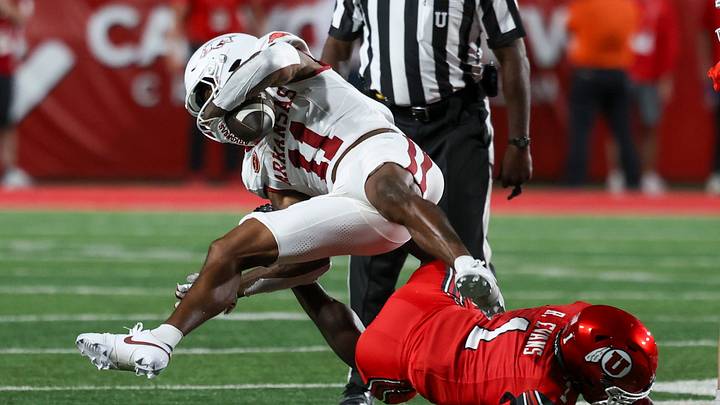
If you thought the Razorbacks’ offense was predictable in last Saturday's loss to Utah, you weren't alone.
Speaking to their radio affiliate, ESPN 700, Utah safety Nate Ritchie said, "We saw a lot of cues that could tell us when it's [a] run or pass, so [we] were just able to capitalize on those things. When it was a pass, man, we were ready to party. When it was a run, we were able to rally to the rock and play hard."
Perhaps this is why the Hogs threw an interception on a routine screen play -- or at least what we can naively tell ourselves.
#GoUtes | #RSNB | 📺 @ESPNCFB https://t.co/K5Zp0NliDz pic.twitter.com/GgZh8qhWlw
— Utah Football (@Utah_Football) September 13, 2026
While the Razorback offense finished with over 300 yards, much of it came in garbage time, when the game was already out of reach. Starting QB KJ Jackson was 14/34 for only 139 yards and the aforementioned screen-play interception. On the ground, the rushing attack could only muster 61 yards, averaging just 2.2 yards per carry.
While the skill players typically get the headlines, the big boys up front on the offensive line had the resistance of a dead tree limb, allowing would-be rushers and run stoppers in the backfield before Jackson or running back Sutton Smith could even blink.
Backup quarterback AJ Hill provided a spark and led the Hogs down the field on a late touchdown drive, but it's hard to take much away from that, seeing as the Utes ' 1s were long off the field.
Keeping the Utah players' quotes in mind, the generous view is that tipping plays contributed at least in part to the offensive ineptitude. If the Hogs want any chance of improving offensively, perhaps it starts with just correcting a lineman’s stance?
Arkansas Should Be Thanking Those Utah Players

Coach Silverfield downplayed the Utah players' comments at his Monday press conference. However, he did acknowledge that the offensive line was tipping plays with their stances in the North Alabama game.
It's possible that Silverfield is publicly downplaying the impact of offensive “tells” because he doesn't want to imply that the sky is falling. Surely -- and surely, right? -- they are making changes behind closed doors and placing major emphasis on disguising play calls.
While you can commend the coach's hard work, it's alarming that these potential measures are even necessary. Practice time is scarce and valuable. Spending that time correcting offensive tells should not be a consistent area of emphasis for players who are now on salary.
Of course, these are things that can be corrected in film sessions -- as Silverfield claims they were after the North Alabama game. But imagine the alternative if they had not been prompted to take corrective action by the Utah players’ comments. Would the coaching staff even look for clues as to why the Utah defense seemed to know the play call ahead of time?
At least now, if the team can learn from its mistakes, they can place even more emphasis on offensive execution by playing things close to the vest.
Fixing a stance is easy; likewise, hypothetically, making sure the receiver’s mouthpiece is in his mouth on both run and pass plays would be a good start.
Football is hard enough, as is, without telegraphing plays to the other team.
Perhaps fixing something as fundamental as not tipping your play calls can lead the Hogs to find some degree of competency on the offensive side of the ball. Judging by the last two weeks, is it likely? No. But with 10 games left in the season, the Hogs already look desperate. Fixing forced errors is as good a place as any to start.
 Add us as a preferred source on Google