

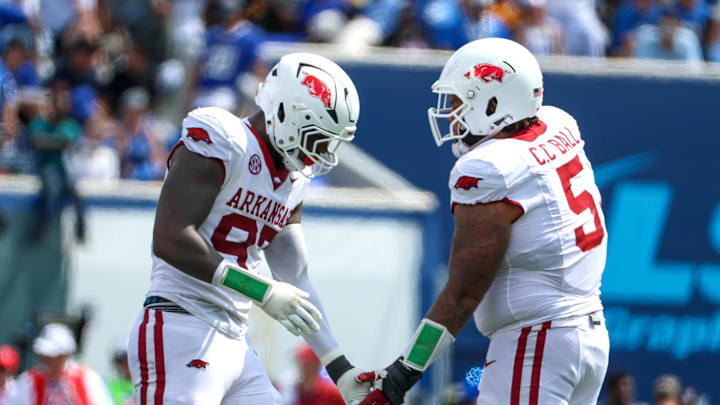
When the dust settled on a turbulent season in Fayetteville, one thing was clear: Arkansas football had a cornerstone to build around. His name is Quincy Rhodes Jr.
A year ago, Rhodes wasn’t just the best defender on the roster, he was the lone bright spot on a unit that struggled mightily. While the Razorbacks endured coaching uncertainty and defensive breakdowns, the junior edge rusher kept coming. Even after head coach Sam Pittman was fired, Rhodes never wavered. With no clarity on who would take over the program and every reason to consider his options, he stayed locked in.
That decision may ultimately define the next era of Arkansas football.
Quincy Rhodes Jr. Anchors the Razorbacks’ Defense
Rhodes was a nightmare for opposing quarterbacks in 2025. He led the team with eight sacks, consistently collapsing pockets and forcing hurried throws. His first step off the line was explosive, his motor relentless. On a defense that often looked disorganized, Rhodes was chaos with purpose.
NFL scouts noticed.
There were first-round projections tied to his name for the 2026 NFL Draft if he chose to declare. In today’s transfer portal era, where elite edge rushers can command significant NIL deals and plug into ready-made contenders, Rhodes could have left for a higher-profile situation and cashed in.
He didn’t.
That choice speaks volumes, about the culture being built and about Rhodes himself. It’s one thing to dominate when things are stable. It’s another to stay when adversity hits. Rhodes chose leadership over leverage.
A New Era Under Ryan Silverfield
New head coach Ryan Silverfield inherits a program desperate for defensive identity. The Razorbacks were statistically among the worst units in the country last season:
- 33.8 points allowed per game (No. 129 FBS)
- 239.5 passing yards allowed per game (No. 104 FBS)
- Nearly 186 rushing yards allowed per game (No. 116 FBS)
- 425.2 total yards allowed per game (No. 122 FBS)
- 31 plays of 30+ yards allowed (No. 119 FBS)
The numbers tell part of the story. The film told the rest.
Arkansas frequently gave up chunk plays. Players were out of position, took poor angles, lost contain, and too often appeared disconnected. It wasn’t just about talent, it was about discipline, communication, and accountability. At times, it looked like 11 individuals rather than one cohesive defense.
That has to change.
Enter new defensive coordinator Ron Roberts.
Roberts is known for flexibility: multiple fronts, disguised pressures, and tailoring schemes to personnel rather than forcing players into rigid roles. That philosophy could be exactly what Arkansas needs.
Expect Rhodes to move around being utilized in multiple different ways such as, standing up, putting his hand in the dirt, rushing from wide alignments, even sliding inside in certain packages. In a multiple-front scheme, an elite edge rusher becomes the chess piece that makes everything else work.
If offenses have to slide protection toward Rhodes on every snap, it creates one-on-one opportunities for Arkansas’ influx of transfer talent. And the Razorbacks were active in the portal, adding pieces designed to raise both the floor and the ceiling of this defense.
The new motto around the program is simple: compete and earn everything. From coaches to players, no one is promised anything.
That mindset fits Rhodes perfectly.
He didn’t run and leave when the going got tough. He didn’t chase the quickest payday. He stayed to lead a turnaround. In an era where roster turnover is constant, that kind of presence matters inside a locker room. Players will gravitate to him because of this.
Rhodes now becomes more than just Arkansas’ best pass rusher. He becomes the standard.
Crucial 2026 Season Ahead
And if Roberts’ scheme brings structure to the chaos that defined last year, Arkansas’ defense doesn’t need to become elite overnight it just needs to become competent, connected, and consistent.
There’s legitimate hope that this unit can take a significant step forward by 2026. It almost has to.
The schedule won’t offer much mercy, and in the SEC, offensive firepower is relentless. Arkansas won’t survive shootouts every week. It needs a defense that can get off the field, limit explosive plays, and close games in the fourth quarter.
If Rhodes delivers another All-SEC caliber season and the new staff successfully instills discipline and accountability, the Razorbacks’ defense could transform from liability to identity.
And it all starts with the player who chose to stay when it would’ve been easier to leave.
 Add us as a preferred source on Google