

The transfer portal giveth, and the transfer portal taketh away.
Overall, head coach Ryan Silverfield and his staff deserve real credit for how they navigated this portal cycle. Arkansas avoided panic moves, filled key roster holes, and set itself up with both short-term contributors and long-term developmental pieces. That alone is a win in today’s chaotic college football landscape.
Still, that doesn’t mean there weren’t a few what-if names along the way.
Arkansas and Silverfield’s Transfer Portal Misses
The Razorbacks were legitimately linked to several high-impact transfers who ultimately landed elsewhere. None of these misses crippled the roster, but each would’ve been a major addition and a luxury rather than a desperate need. Here are three portal targets Arkansas surely wishes had worked out a little differently.
QB Katin Houser
Quarterback was never a must this cycle, but Katin Houser would’ve made the future much clearer.
Houser, a former four-star prospect with real in-game experience and production, would have entered Fayetteville with one year of eligibility remaining. That alone made him extremely appealing. Arkansas currently has intriguing young quarterbacks in KJ Jackson, AJ Hill, and Hank Hendrix, all of whom possess real upside. However, upside doesn’t always equal readiness, especially at the SEC level.
Houser would’ve given the Razorbacks breathing room.
Instead of feeling pressure to rush one of those young quarterbacks into action in 2026, Arkansas could’ve allowed them to develop naturally while Houser handled the reins and compete in doing so. If he balled out, and which he definitely could have, Arkansas would’ve had both stability and flexibility moving forward.
That doesn’t mean the current quarterback room is lacking. Far from it. But Houser’s experience and steadiness would’ve provided a sense of relief and a clear bridge to the next era. Whether Jackson, Hill, or Hendrix is ready to fully take over in 2026 is a question for another time, but Houser would’ve softened that uncertainty considerably.
OL Carius Curne
This one stings.
Carius Curne, an Arkansas native, had been linked to the Razorbacks for a while. Coming home felt realistic. Arkansas was part of his original recruiting process, and the fit made sense on multiple levels.
According to On3 Sports, Curne ranked as the 26th overall player in the transfer portal, making him one of the most coveted offensive linemen available. Losing him to Ole Miss, an in-conference rival, only adds salt to the wound.
Curne’s value lies in his versatility. He can line up at multiple spots along the offensive line and contribute immediately in both the run and pass game. His presence would’ve strengthened Arkansas up front and provided lineup flexibility that’s incredibly valuable over a long SEC season.
That said, this is where Silverfield’s portal work deserves praise. Arkansas still managed to bring in several offensive linemen capable of competing for starting jobs right away while also building for the future. Curne would’ve been a massive get, but his absence doesn’t leave the Razorbacks scrambling.
He was a difference-maker opportunity, not a roster-saving necessity.
RB Cam Cook
If there’s one miss that really makes you dream, it’s Cam Cook.
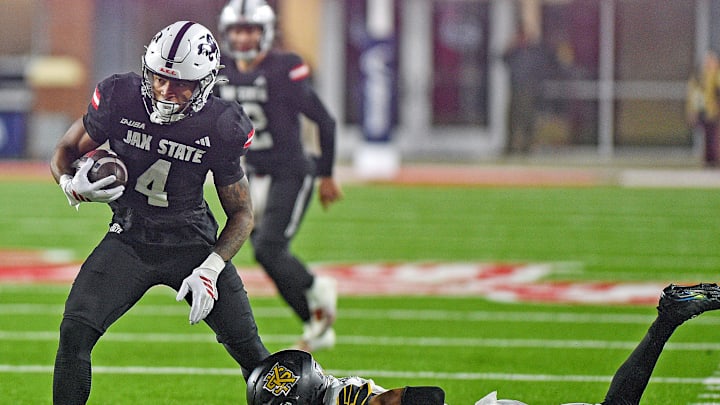
Cook was heavily linked to Arkansas, largely because of his strong connection to his former offensive coordinator Clint Trickett, who is now serving as the Razorbacks’ quarterbacks coach after arriving from Jacksonville State. The fit seemed natural, and the dots were easy to connect. Instead, Cook ultimately chose West Virginia, and his production makes it clear why he was one of the most sought-after backs in the portal. He led the nation with 1,659 rushing yards, scored 16 rushing touchdowns (tied for sixth nationally), averaged an impressive 5.6 yards per carry, and showed proven value as a pass catcher out of the backfield.
Cook wasn’t just productive, he was one of the most complete running backs in the country. With Arkansas losing starting back Mike Washington to the NFL Draft, Cook would’ve stepped in as an immediate centerpiece of the offense.
Silverfield didn’t leave the position unattended, though. Arkansas added electric playmaker Sutton Smith from Memphis and former four-star Michigan running back Jasper Parker. Both bring high ceilings and legitimate SEC traits.
Still, Cook’s proven production at the college level made him incredibly enticing. He wasn’t just potential, he was certainty. And in a conference where every yard matters, that certainty is hard to replace.
 Add us as a preferred source on Google